Provably Fair in Crypto Casinos: How Blockchain Replaces Trust with Mathematical Proof



Almost every online casino makes the same unspoken promise: their software for spins, card shuffling, or dice rolls is completely fair. The problem is that in traditional gambling you never actually see the mechanism that produces these results. Essentially, you are asked to trust a "black box" - licensed and audited, but still closed - while you place real money on outcomes that you cannot reproduce yourself.
Traditional platforms use server-side random number generators (RNG). Yes, reputable operators regularly have them tested by independent laboratories. But such checks are periodic, not continuous. In real time, you cannot verify why a spin produced exactly that result. The online gambling market is growing rapidly (forecasts suggest it will exceed $153 billion by 2030), and the blind trust model is starting to look increasingly outdated.
Crypto casinos did not just introduce new payment methods - they brought a new philosophy: don't ask players to trust you, give them proof instead.
What Does "Provably Fair" Actually Mean?
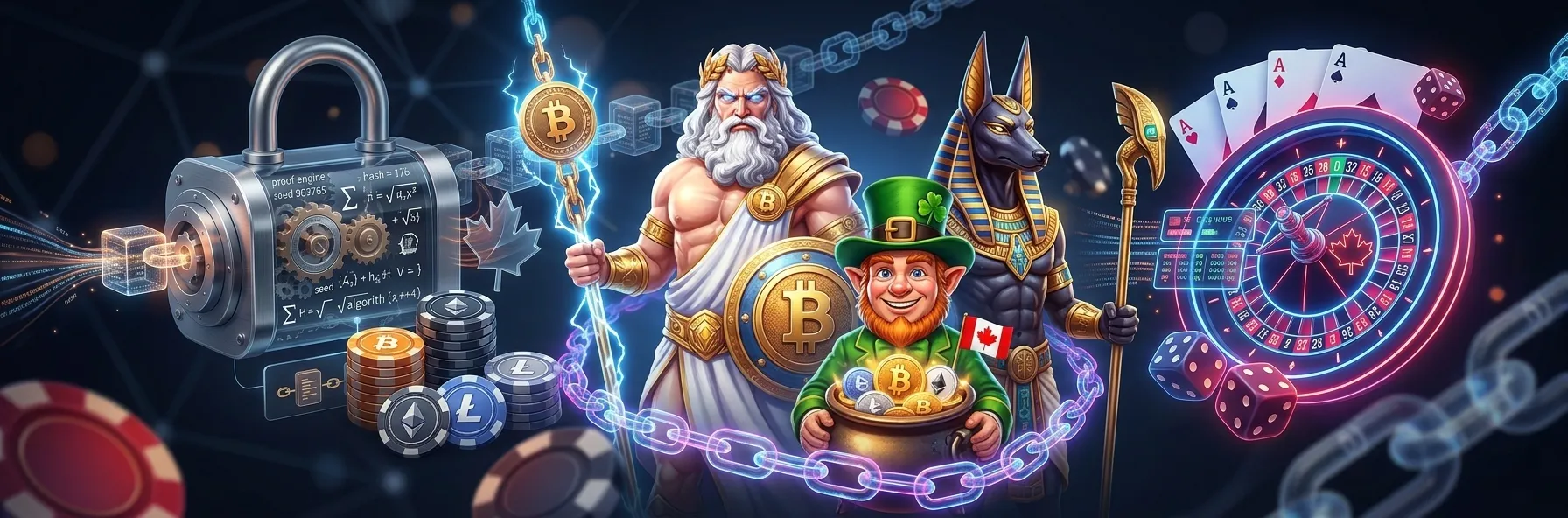
Provably fair is not just a nice marketing slogan. It is a cryptographic method designed to prove that a game was not manipulated after you placed your bet.
The system works so that fairness can be observed, not simply certified. The main idea is simple: if a result is generated from known input data using a known algorithm, then anyone can reproduce it. And if you can reproduce it, you can verify it.
The Mechanics: Seeds, Hashes, and Verification
Most provably fair systems use three key components:
Server seed: This is a secret value created by the casino. Before the game begins, the casino publishes the hash of this seed (usually via SHA-256). This guarantees that if the casino later tries to change the seed, the hash will no longer match.
Player seed (client seed): A value generated by the player or their browser. This prevents the casino from having full control over the data that determines your game's outcome.
Nonce: A counter that increases with every new bet. It ensures that results remain unique even if the same seeds are used.
These values are combined (most often through algorithms such as SHA-256 or HMAC-SHA256) to generate a deterministic result - for example, a number between 0 and 100 for dice. When the round ends, the casino reveals the original server seed. You then take the published algorithm, plug in the server seed, your seed, and the nonce, and obtain exactly the same result that just appeared on your screen. The proof here is a reproducible calculation, not empty promises.

How Blockchain Upgrades the Casino Experience

The provably fair logic can technically work without blockchain. However, blockchain adds a crucial second layer of trust - immutable data storage. A decentralized ledger stores information across many nodes, making it extremely difficult to alter records after the fact.
This creates a permanent trail of bets and payouts, seed hashes, and transaction history. Blockchain makes the platform transparent, simplifying audits and demonstrating rule compliance. Beyond transparency, players also gain several tangible benefits:
Lower fees and faster transfers: Crypto reduces dependence on card networks, meaning faster access to winnings.
Global access: Blockchain has no borders, so crypto casinos are accessible even where traditional financial services operate slowly.
Privacy: Playing through crypto wallets allows users to avoid exposing large amounts of banking and personal data.
Reduced hacking risk: Data is distributed across a network rather than stored on a single server, making attacks significantly harder.
Smart Contracts and the End of "Hidden Rules"
Smart contracts are self-executing code on a blockchain that cannot be quietly altered during gameplay. In such systems, the smart contract strictly controls betting rules, payout formulas, and publicly visible odds.
This does not eliminate the house edge (the casino advantage still exists), but it makes the payout structure explicit, verifiable, and consistent. When rules are embedded in code, disputes shift from "what did the operator do?" to "what is written in the contract?"

The Future: DAOs and Peer-to-Peer Betting
The industry is gradually moving from the traditional casino format toward a protocol-based platform model. What does that mean in practice?
-
Decentralized governance (DAOs): Token holders can vote on adding new games, adjusting fees, or changing reward policies. The platform evolves together with the community.
-
Peer-to-peer (P2P) betting: Players can place bets directly against each other, while smart contracts automatically hold funds in escrow and pay out the winnings. There is no intermediary dictating the odds.
Of course, these models introduce new challenges - from dispute resolution to regulatory issues and complex interfaces. But the direction is clear: online gambling is moving from systems based on blind trust to systems based on mathematical proof.
Verdict
Provably fair technology will not magically make you a millionaire - the mathematics of casinos (house edge) remains the same. However, it solves the industry's main problem: transparency. If you value privacy, fast payouts, and the ability to personally verify the fairness of every spin through hashes and seeds, crypto casinos provide functionality that traditional platforms simply cannot physically offer.
Amanda Shimmer is the Chief Editor at CasinosInCanada and an experienced casino expert who ensures all guides, reviews, and industry investigations remain accurate, transparent, and helpful for players.




FAQ
It is a cryptographic verification method. It proves that the result of a game (spin, dice roll) was not altered by the operator after you placed your bet.
No. Provably fair systems do not eliminate risk or change the laws of probability. They only guarantee the fairness of the outcome generation process.
After the round ends, the casino reveals the server seed. You can use the published algorithm by combining the server seed, your client seed, and the nonce to reproduce and confirm the result.
Not necessarily. The logic itself can function without blockchain. However, blockchain adds immutable data storage, making the system even more reliable.
No system is 100% secure, but decentralization significantly increases the cost and complexity of large-scale attacks. Traditional casinos store databases on centralized servers, which are easier targets.
No, if the smart contract is verified and public. It makes the payout structure and the house edge transparent, verifiable, and consistent, eliminating the risk of hidden rule changes during gameplay.


















I switched to crypto casinos purely because of the withdrawal speed.
Crypto is a scam!!!
Fairness is fairness, but don’t forget that the house edge still exists. The math is still against you in the long run - now you just know for sure that you lost “fairly.” Still, I admit it’s better to see a hash on the blockchain than simply trust a Curacao license that was bought for pennies.