Revolut Is Removing USDT: Key Deadlines and What Customers Should Do



Revolut has started notifying customers that Tether (USDT) will be removed from its crypto platform later in 2026. Users holding the stablecoin have until the end of August to sell their balance or move it to an external wallet.
The company has not pointed to one specific reason for the decision. Instead, Revolut says it regularly reviews supported tokens and may adjust its crypto offering based on regulatory requirements and risk considerations.
The move follows a staggered schedule rather than an immediate shutdown, giving existing USDT holders several weeks to decide what to do with their funds.When Revolut Will Stop Supporting USDT
The first restriction came into effect on 6 July 2026 at 12:00 PM GMT. From that point, customers could no longer buy USDT through the Revolut app.
The next deadline is 30 July 2026 at 12:00 PM GMT, when Revolut will stop accepting new USDT deposits. Transfers sent before the cutoff may still be credited once they pass the platform’s usual checks. Deposits initiated after the deadline will no longer be supported.
Existing holders can continue selling or withdrawing USDT until 31 August 2026 at 12:00 PM GMT. Standard daily transaction limits will apply, which means customers with larger balances may need to complete several withdrawals.
After the final deadline, deposits, withdrawals and other USDT transactions will be disabled. Any Tether still held in a Revolut account will be automatically converted into the customer’s base currency using the exchange rate available on that day.
Revolut says the converted funds should appear in the customer’s main balance within seven business days.
Small leftover amounts will also be handled automatically. If the remaining USDT is worth less than the smallest tradeable unit of the customer’s base currency — for example, below €0.01 — Revolut will liquidate the balance without requiring any action from the user.
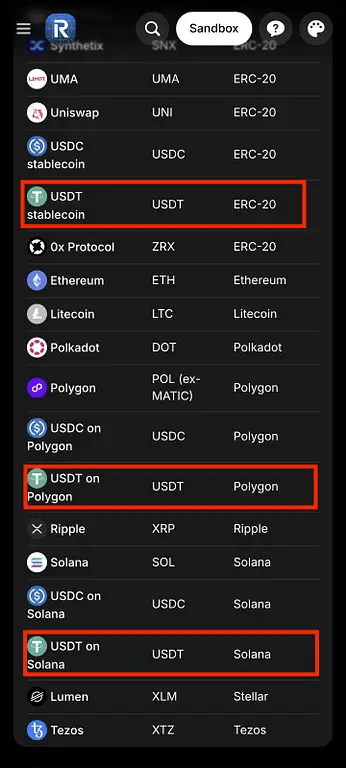
As of 1 July 2026, USDT was still visible in Revolut’s supported crypto asset list, including versions running on Polygon and Solana. That listing does not change the announced phase-out schedule.

Why Revolut Is Delisting USDT
Revolut describes the decision as part of its regular review process. According to the company, crypto assets may be removed because of regulatory issues, insufficient liquidity, falling token value, reputational concerns or other platform risks.
In the case of USDT, the timing closely matches wider changes across the European crypto market.
The EU’s Markets in Crypto-Assets regulation, commonly known as MiCA, introduced stricter rules for stablecoin issuers. These include requirements covering reserves, authorisation, disclosure and token redemption.
Tether has not fully aligned USDT with the MiCA framework, and several major crypto platforms have already restricted or removed the stablecoin for European customers. Binance and OKX were among the exchanges that reduced USDT support during the early stages of the regulation’s rollout.
Revolut has not said that MiCA is the only reason behind the delisting. Still, the regulatory environment appears to be a major part of the broader risk assessment.
Previous Complaints About USDT Transfers
The delisting also comes after years of complaints from some Revolut customers about delayed crypto transactions.
Users on forums such as Reddit have described large USDT deposits being held for extended compliance checks. In one widely discussed case, a five-figure transfer reportedly remained frozen for around seven weeks before Revolut eventually returned the money to the customer’s external wallet.
These cases are often linked to anti-money-laundering checks, source-of-funds reviews and Revolut’s cautious approach to crypto transactions. They do not mean every transfer will face a delay, but they show why leaving a large withdrawal until the final days of August may be risky.
This can be especially relevant for customers receiving USDT from crypto exchanges, betting platforms or online casinos. Larger transactions may attract additional checks, and a pending review could make it harder to move funds before support ends.

What USDT Holders Can Do
Customers currently holding USDT have three main options.
The simplest is to sell the stablecoin inside the Revolut app. Users can open the Crypto section, select USDT and choose the sell option. Daily trading limits may apply.
The second option is to withdraw USDT to an external crypto wallet or another platform that still supports the asset. Before sending funds, customers should check the wallet address and confirm that the receiving platform supports the same blockchain network.
Sending USDT through the wrong network can result in lost funds or a complicated recovery process. For larger balances, making a small test transaction first may help confirm that the address and network are correct.
The final option is to take no action. Revolut will automatically convert any USDT left in the account after 31 August. This may be convenient, but it removes the customer’s ability to choose the timing and exchange rate of the conversion.
Revolut’s crypto terms also state that the company is not responsible for losses caused by a delisted token losing value or falling to zero. Customers who plan to wait for automatic conversion should keep that condition in mind.
Revolut has not revealed how many users are affected or the total value of USDT currently held on the platform. For customers who do need to move a balance, acting before the final deadline leaves more time to deal with transaction limits or additional compliance checks.
Olivia Grant is an iGaming news reporter at CasinosInCanada who covers casino industry updates, regulations, and market developments.