GO by Pump.fun: Crypto Tasks, Meme Coins, and the Bounty That Left Everyone Uneasy



Pump.fun decided to expand its meme-coin ecosystem and launched the GO bounty service. The idea is simple: one user comes up with a task, and another completes it for crypto. The name is as direct as it gets — GO, meaning something like “let’s go” or “go ahead.”
At first glance, the service looks like another crypto toy sitting somewhere between challenges, memes, and cheap viral marketing. The tasks ask people to get a tattoo, shave their head, feed homeless people, take a photo in a specific place, or perform some odd public stunt. Sometimes it all looks almost harmless. Sometimes it very much does not, especially when the tasks include ads for questionable projects and outright scams.
Payment depends on the customer’s imagination and how unhinged the task itself is. In some cases, it is a few dozen dollars in crypto equivalent; in others, the amount reaches a couple of hundred. Rewards are paid in SOL, and the customer loads the crypto in advance while specifying how many performers can receive the reward. The funds are frozen automatically, and any remaining balance can only be withdrawn after the deadline.
In other words, the mechanics are built so that a bounty looks less like a simple post and more like an almost-ready deal: the money is already there, and the performer only needs to prove that the job was done. Under the service’s rules, proof is published directly on the task page — a photo, video, or another confirming material.

Some of the more expensive tasks have already turned into stories of their own. For example, users were offered more than $2,000 to speak with murderer Henry Novak. That is no longer just a crypto challenge in the “take a photo by this sign” category — it is an attempt to turn a crime story into a paid performance.
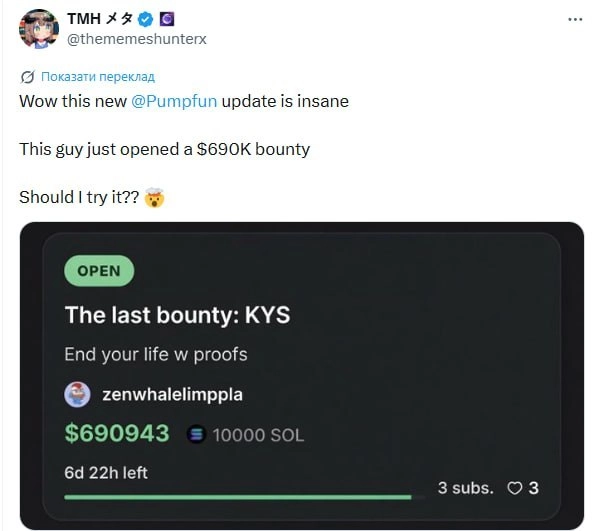
But the real aftertaste appeared almost immediately after GO launched. Within a few hours, one user posted a task for 10,000 SOL — almost $700,000 — with the caption The last bounty: KYS. The wording was clear: it was a call for suicide.
That was the point where the fun crypto service suddenly showed its most unpleasant side. If a platform is built around the idea of “do something for money and show proof,” then moderation cannot be a secondary feature — it has to be the foundation. Otherwise, the line between a meme, trash content, human exploitation, and direct danger disappears far too quickly.
The admins eventually removed the task after several hours. Formally, they reacted. But the fact that a bounty like that could appear, stay on the platform, and draw attention is already telling enough.

Olivia Grant is an iGaming news reporter at CasinosInCanada who covers casino industry updates, regulations, and market developments.